In a 2016 article for Inc magazine, titled “5 Choices You’ll Regret Forever”, Travis Bradberry drew on Bronnie Ware’s 2011 book, The Top Five Regrets of the Dying: A Life Transformed by the Dearly Departing.
Bradberry frames regret largely through the choices we make. But Bronnie Ware’s original first regret is more fundamental: people wished they had found the courage to live a life true to themselves, rather than the life others expected.
That is not necessarily a problem of wrong decision-making. Rather, I’d say it’s a problem of judging our decisions against the wrong indicators – namely, someone else’s.
When this is the case, it’s a problem of authorship. Who is actually writing the script for your life?
And the act of authorship, the quality of the script, comes down to fluency. How well do you know the evolving truth of the main character: their proclivities, the forces they respond to (or don’t), and the stage on which they have to perform?
1. The tyranny of “should”
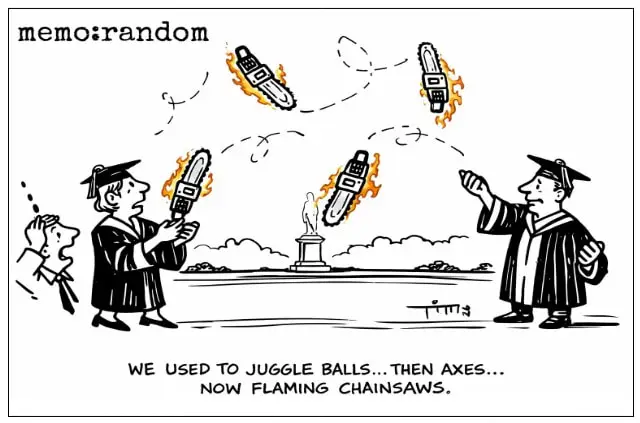
Most people don’t abandon their aspirations in one dramatic decision. They gradually surrender them to a growing collection of reasonable obligations.
“I should pursue the promotion.” “I should make more money.” “I should be responsible.” “I should use my qualifications.” “I should be grateful for the opportunities I’ve been given.” “I should finish what I started.” “I shouldn’t disappoint people.”
Individually, these expectations can be sensible, even honourable.
Collectively, they can become a life designed around satisfying expectations rather than expressing who we are.
And the trap is particularly effective for capable people. We’re often rewarded for doing things we are good at, even when those things aren’t what we’re naturally drawn towards.
Being good at something is not the same as being fulfilled by it.
Success can make the trap harder to recognise because the external evidence suggests we’re doing everything right.
2. Neil Young’s “Thrasher” offers something more challenging
In “Thrasher”, from Rust Never Sleeps, Young describes companions who have become “poisoned with protection”.
He chooses to continue on his own path rather than remain with them.
The song’s imagery suggests people who once sought discovery but eventually became attached to the comfort, security and established identities they had built.
Young’s decision is not without loss. He recognizes what he is leaving behind. But he also recognizes what staying would cost him.
The thrasher itself becomes a powerful image of time, mortality and reckoning. Eventually, whatever we have built, protected or accumulated must confront the passage of time.
And that raises a more interesting question than whether we’ve made the correct decisions:
Have we become so invested in protecting the life we’ve built that we’ve stopped living the life we wanted?
That is a very different form of regret.
3. But not every “should” is a prison
This is where I would challenge both the article and an overly romantic interpretation of Young.
Some obligations are worth carrying. Family, friendship, service, professional responsibility and keeping our word are not simply expectations imposed upon us. They can be deeply meaningful expressions of who we are.
Likewise, following every desire isn’t authenticity. Sometimes our desires reflect avoidance, fear, impatience or a wish to escape difficult responsibilities.
The distinction is between obligations we consciously choose and expectations we have simply absorbed.
There is a difference between sacrificing something because it serves a purpose we believe in and sacrificing it because we cannot bear to disappoint someone.
And there is a difference between working hard at something that expresses our genius and working hard at something because other people have convinced us we should.
4. The five regrets look different through this lens
- Living for others’ approval: The issue isn’t simply listening too much to other people. It’s allowing their expectations to supersede our own judgement.
- Working too hard: Hard work itself is not the enemy. Spending decades working hard at the wrong things may be. Passionate, meaningful work can be one of life’s great pleasures.
- Not expressing feelings: This isn’t just about emotional disclosure. It’s about having the courage to acknowledge what we need, what we want and what no longer fits.
- Losing touch with friends: Young has linked the song to his departure from Crosby, Stills, Nash & Young. That gives us a genuine counterpoint. Sometimes living authentically, and developing into that next version of ourselves, means accepting that certain companions cannot accompany us. They may not fit the next version of us, particularly when we’re heading somewhere creatively that they cannot follow.
Young doesn’t label these friendships failures. He recognizes that they are in tension with his own direction. - Not allowing happiness: Happiness isn’t entirely a choice, nor should it be our only goal. A meaningful life can involve grief, discomfort, uncertainty and difficult decisions. And people differ in their baseline and range of happiness. Sometimes the greatest satisfaction comes from doing something hard because it matters to us.
A sentiment often attributed to Ralph Waldo Emerson places usefulness, honour and compassion ahead of happiness as life’s purpose. Whether or not those exact words were his, the question of purpose and legacy remains.
Much later, Ricky Gervais offers another perspective: happiness needn’t be a mystical, unreachable state or a measure of our net worth. It can be much closer to feeling comfortable in our own existence. Relationships and connections matter more than the status we chase.
By becoming more fluent in what happiness has meant to us, what it means now, and what we imagine it might mean in the future, whether that means valuing free education, nature, time with a partner, or just walking a dog, we stop bartering our current peace for validation.
Whether you lean towards Emerson or Gervais, finding your best life is recognizing that “feeling good about your life” shouldn’t be a lagging indicator. Instead, it’s a sense of direction.
5. Living within your genius, style and frame
There is another important dimension.
Each of us has a particular combination of capabilities, interests, instincts, temperament, values and ways of engaging with the world.
Some people are natural builders. Others are explorers, teachers, caregivers, artists, challengers or stabilizers.
We can become remarkably accomplished in roles that require us to suppress those qualities.
And we can become so good at fulfilling other people’s expectations that we lose sight of what we might have contributed had we followed our own inclinations.
Young’s image of having his “own row left to hoe” is particularly relevant.
He isn’t renouncing responsibility or effort. He is choosing the work that is his to do.
That is an important distinction.
The goal isn’t to escape responsibility. It is to exercise responsibility in a way that honours our particular nature, our commitments and what we have to offer.
Where I think the strongest argument lies
Bradberry’s article tells us to make better decisions so we don’t accumulate regrets.
Young suggests something more unsettling: we can make all the sensible decisions, satisfy every expectation, achieve considerable success, and still find that we have lost our way.
Emerson reminds us of purpose and legacy.
Gervais reminds us that none of this has to be contrary to what makes us happy in the moment.
Where we go wrong is in the “shoulds” someone else wrote that don’t fit. We are the authors, and we need to keep the pen.
Are you “shoulding” all over yourself? That is the danger of too many of the wrong “shoulds”.
We gradually exchange curiosity for certainty, exploration for protection, and our own ambitions for an increasingly elaborate set of obligations, or worse: the blueprint of someone else’s life, which for them was natural, but for us is imitation.
Yet the answer cannot simply be to abandon every obligation and follow our desires. That would be another kind of self-deception.
A well-lived life isn’t one without sacrifice, deeper purpose or duty. It’s one in which we understand what we’re sacrificing, why we’re doing it, and whether the life we’re building is actually ours, and what we might leave behind for others to harvest.
The thrasher comes for everyone eventually.
The question is not whether we have worked hard, fulfilled our duties or achieved success.
It’s whether, when our time comes, we can recognize our own life in the one we’ve lived and what we’ve given and left behind. Has our life felt genuinely, happily ours more often than not?